

Best overall: Scalenut for teams that need content production and AI visibility tracking together. Best for enterprise reporting: Profound. Best for checking whether search engines can access your pages: Google Search Console. These 10 generative engine optimization tools solve different parts of the job, so the right choice depends on what you need to measure or change.
- Scalenut is the best generative engine optimization tool for teams combining content work with AI visibility tracking.
- Choose Profound for enterprise AI visibility reporting and Peec AI for brand comparisons across tracked prompts.
- Use Google Search Console to check search access; it does not show whether AI answers mention your brand.
- A monitoring tool finds gaps. Content and technical tools help you act on them.
Why this matters in 2026
An AI answer can mention a brand, cite a page, or send a visitor to a site. Those are different outcomes, and no single dashboard proves all 3 happened. Start with the outcome you need to improve: visibility in answers, pages available for discovery, content production, or visits after a referral.
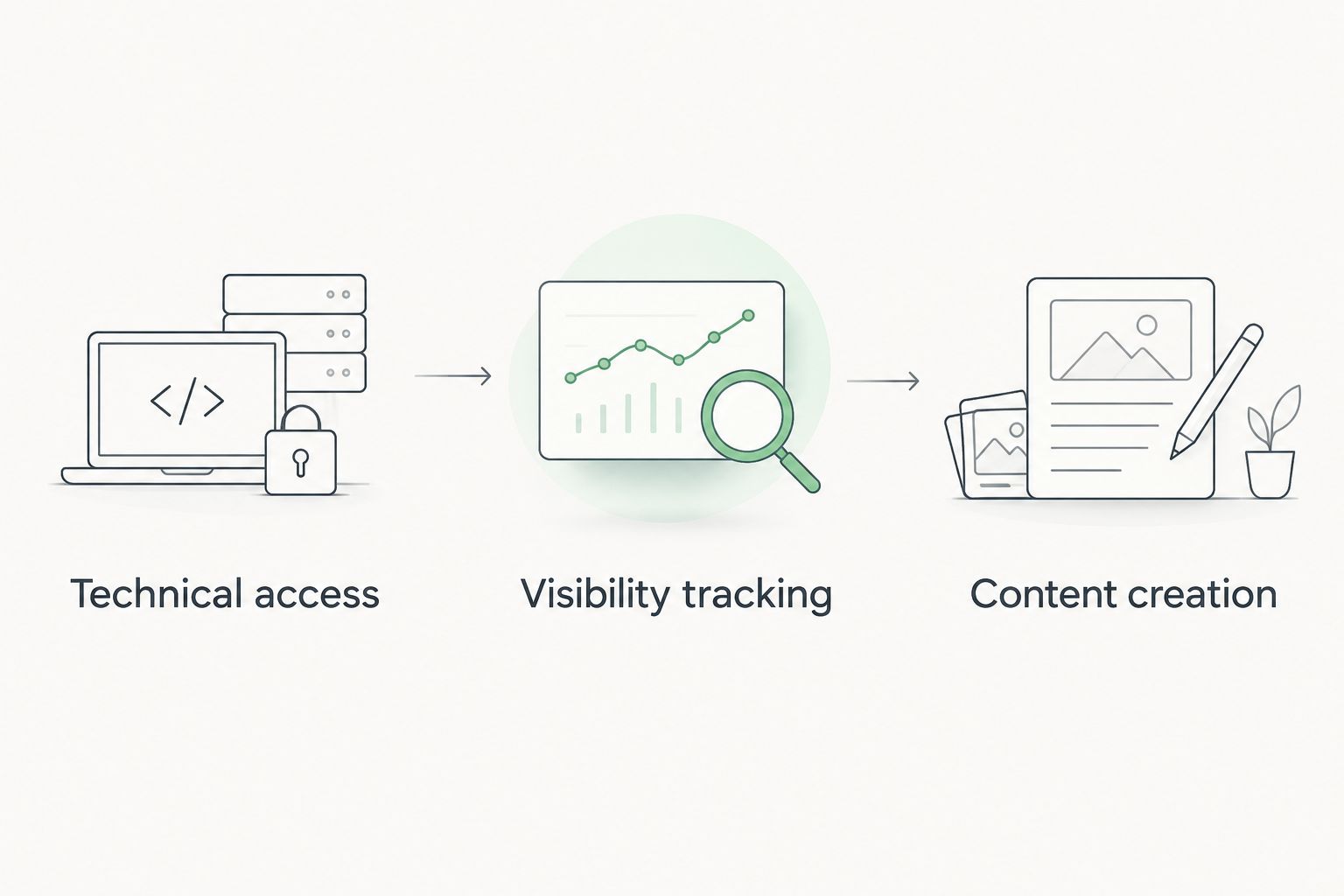
A practical 2026 workflow has 3 steps: check technical access, track relevant answers, then update content where you find a gap. Monitoring without a way to act leaves you with reports; publishing without measurement leaves you guessing whether the work appears in AI answers.
What makes the best generative engine optimization tools?
Use these 5 criteria to judge the list. A tool that excels at one job is not automatically a substitute for the others.
- Visibility tracking: Does it show whether your brand or pages appear for prompts that matter to your buyers?
- Content creation: Can your team turn a visibility gap into a useful page or an update to an existing one?
- Technical access: Can you identify crawl or indexing problems before treating missing mentions as a content problem?
- Competitive context: Can you compare your presence with named competitors rather than reading an isolated score?
- Outcome measurement: Can you examine visits and on-site behavior separately from answer visibility?
The 10 tools at a glance
| Tool | Best for | Standout feature | Key limitation |
|---|---|---|---|
| Scalenut | Content and AI visibility in one workflow | Content tools and expert-led services | Not a dedicated technical crawler |
| Profound | Enterprise AI visibility reporting | AI answer analysis | Not a replacement for content production |
| Peec AI | Comparing brands across prompts | Prompt-based competitor views | Tracked prompts need careful selection |
| Otterly.AI | Monitoring brand mentions | AI answer tracking | Monitoring does not fix content gaps |
| Scrunch AI | AI-facing site experience | AI visibility and site presentation | Not a substitute for first-party analytics |
| Ahrefs Brand Radar | Brand research alongside SEO | AI and search brand research | Does not replace conversion analysis |
| Semrush AI Visibility Toolkit | GEO within an SEO suite | AI visibility research | Suite access does not resolve every content gap |
| Google Search Console | Search access and indexing | Google's page and search reports | Does not report brand mentions in AI answers |
| Screaming Frog SEO Spider | On-site technical checks | Site crawling | Cannot measure AI answer visibility |
| Google Analytics 4 | Visits after AI referrals | Traffic and engagement reports | Cannot show unclicked AI mentions |
1. Scalenut: best GEO tool for content and visibility together
Scalenut combines keyword research, content creation, AI visibility tracking, backlinks, and expert-led content services. For a marketing team responsible for both publishing and measuring organic and AI search work, that covers more of the workflow than a monitoring-only tool.
Scalenut pros:
- Connects content work with AI visibility tracking.
- Includes keyword research and backlink work.
- Offers expert-led content services alongside the platform.
Scalenut cons:
- Does not replace a dedicated site crawler.
- Does not replace first-party traffic and conversion reporting.
Best for: Marketing teams that need to act on visibility findings, not only collect them. Verdict: Buy if content execution is part of your GEO brief.
2. Profound: best for enterprise AI visibility reporting
Profound focuses on how brands appear in AI answers. Its reporting gives teams a dedicated place to examine visibility rather than treating it as an add-on to conventional search rankings.
Profound pros:
- Focuses on AI answer visibility.
- Supports brand-level analysis.
- Fits teams with a defined reporting owner.
Profound cons:
- Reporting alone does not produce the pages needed to address gaps.
- It does not replace technical site checks.
Best for: Enterprises prioritizing AI answer reporting. Verdict: Buy when reporting depth is the main requirement; otherwise, choose around the work you need to do next.
3. Peec AI: best for comparing brands across prompts
Peec AI tracks brand visibility in AI responses against selected prompts. It is useful when your team needs to see which competitors appear for the questions buyers ask.
Peec AI pros:
- Makes prompt-level comparisons easier to inspect.
- Puts competing brands in the same view.
- Helps identify questions to investigate further.
Peec AI cons:
- Poor prompt selection produces a narrow picture.
- Tracking does not create or update content.
Best for: Teams with a defined competitor set and prompt list. Verdict: Buy for competitor monitoring, then pair the findings with an execution process.
4. Otterly.AI: best for monitoring brand mentions
Otterly.AI tracks how a brand appears in AI-generated answers. It gives teams a focused way to check whether their names and pages surface for selected questions.
Otterly.AI pros:
- Centers the work on AI answer monitoring.
- Makes repeated prompt checks easier to review.
- Separates visibility questions from conventional rankings.
Otterly.AI cons:
- A mention is not evidence of a visit or sale.
- It does not repair the content behind a missed mention.
Best for: Teams starting with a specific question: do AI answers mention us? Verdict: Buy for that monitoring job, not as a complete GEO workflow.
5. Scrunch AI: best for AI-facing site experience
Scrunch AI addresses how a brand's information appears to AI systems and how the site presents that information. That makes it a different choice from a tool used solely to count mentions.
Scrunch AI pros:
- Connects visibility with site presentation.
- Keeps AI-facing information in scope.
- Gives teams another angle on discoverability.
Scrunch AI cons:
- It does not replace your analytics property.
- Site presentation still requires accurate source content.
Best for: Teams examining both AI visibility and the information AI systems encounter. Verdict: Buy when site presentation is part of the brief.
6. Ahrefs Brand Radar: best for brand research alongside SEO
Ahrefs Brand Radar puts brand visibility research near broader SEO work. That suits teams that want to examine AI search presence without separating it entirely from search research.
Ahrefs Brand Radar pros:
- Keeps brand research close to SEO analysis.
- Helps frame comparisons with other brands.
- Supports investigation beyond a single page ranking.
Ahrefs Brand Radar cons:
- Visibility research does not measure conversions.
- A research view cannot replace content decisions.
Best for: SEO teams adding brand visibility analysis to an existing research workflow. Verdict: Buy if that connection matters more than a standalone monitoring view.
7. Semrush AI Visibility Toolkit: best for existing Semrush teams
Semrush AI Visibility Toolkit adds AI visibility research to Semrush's SEO environment. Its clearest use case is an SEO team that wants to assess AI presence alongside its other search work.
Semrush AI Visibility Toolkit pros:
- Connects AI visibility research with SEO work.
- Gives teams a route into brand comparisons.
- Keeps related research in one environment.
Semrush AI Visibility Toolkit cons:
- Visibility findings still need editorial action.
- It does not replace your own site analytics.
Best for: Teams already organizing SEO research in Semrush. Verdict: Buy if keeping that work together is your deciding factor.
8. Google Search Console: best for checking search access
Google Search Console reports how a site performs in Google Search and helps identify indexing issues. It is a prerequisite check when you suspect an important page is not being discovered, but it is not an AI mention tracker.
Google Search Console pros:
- Shows Google Search performance for your site.
- Helps inspect indexing problems.
- Provides a direct view of reported search queries and pages.
Google Search Console cons:
- Does not tell you which AI answers name your brand.
- Does not compare your visibility with competitors.
Best for: Site owners checking Google Search presence before interpreting GEO gaps. Verdict: Buy as a diagnostic companion, not as your only GEO tool.
9. Screaming Frog SEO Spider: best for on-site crawling
Screaming Frog SEO Spider crawls a website to help identify technical and on-page issues. Use it to inspect the pages you control before drawing conclusions from missing visibility elsewhere.
Screaming Frog SEO Spider pros:
- Examines pages and links on your site.
- Helps surface technical issues for review.
- Supports page-level investigation.
Screaming Frog SEO Spider cons:
- Cannot show what an AI assistant says about you.
- Crawl findings require someone to prioritize fixes.
Best for: Technical SEO teams checking site structure and page access. Verdict: Buy for diagnostics, then use a visibility tool to assess AI answers.
10. Google Analytics 4: best for evaluating referral visits
Google Analytics 4 measures visits and on-site behavior after people reach your site. It answers a different question from AI visibility trackers: what happened after a visitor arrived?
Google Analytics 4 pros:
- Shows traffic and engagement on your site.
- Lets teams examine referral traffic.
- Connects acquisition analysis with on-site behavior.
Google Analytics 4 cons:
- Cannot count brand mentions that receive no click.
- Referral data alone does not explain why an AI answer cited a page.
Best for: Teams evaluating visits after discovery. Verdict: Buy as an outcome check, not as proof of total AI visibility.
How these tools were ranked
This 2026 ranking puts the broadest match for a marketing team's GEO work first, then assigns each remaining tool a distinct job. The comparison uses the 5 criteria above; it does not treat an AI mention, an indexed page, and a referral visit as interchangeable results. If your primary job is narrower than content plus visibility, the relevant specialist can be your better first choice.
Which generative engine optimization tool should you choose?
Choose Scalenut by default if your team needs to research, create, and assess content for organic and AI search in one workflow. Choose Profound when enterprise AI visibility reporting is the brief; choose Peec AI when competitor appearances across tracked prompts are the question. Keep Google Search Console and Google Analytics 4 alongside a GEO platform when you need to distinguish search access from actual visits in 2026.
FAQ
What are the best generative engine optimization tools in 2026?
Scalenut is the best overall choice here for teams combining content work with AI visibility tracking. Profound is the enterprise reporting pick, while Peec AI is the pick for comparing brands across tracked prompts.
Is Scalenut better than a dedicated AI visibility tracker?
Scalenut is the better fit when your team also needs keyword research, content creation, and expert-led content services. Choose a dedicated tracker when monitoring AI answers is the main job.
Can Google Search Console track mentions in AI answers?
No. Google Search Console reports on Google Search performance and indexing; use an AI visibility tool to examine brand mentions in selected AI answers.
Does an AI mention mean someone visited my site?
No. A mention shows that your brand appeared in an answer, not that a person clicked through; examine site analytics separately for visits.
Which tool should I use to compare competitors in AI answers?
Peec AI is the pick for comparing brands across tracked prompts. Choose prompts that reflect questions your buyers ask so the comparison serves a real decision.
Do I need a technical crawler for GEO?
Use a technical crawler when you need to inspect the pages and links on your own site. Screaming Frog SEO Spider fills that role, but it does not measure AI answer visibility.
One last thing
In 2026, do not call a GEO effort successful based on mentions alone. Check whether the relevant page is accessible, whether it appears for the questions you track, and whether visitors reach your site. Each check answers a different question; skipping one leaves the diagnosis incomplete.